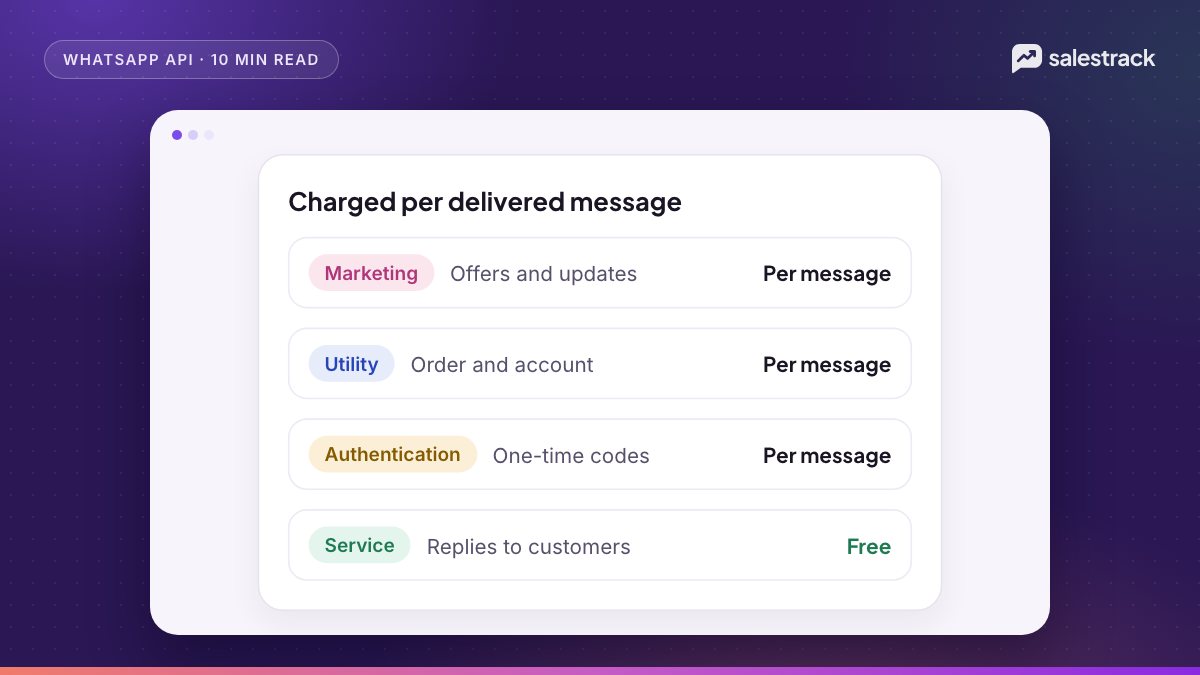
WhatsApp Business API pricing is per message. Since 1 July 2025 Meta charges for each message your business sends that is delivered, at a rate set by two things: the message category (marketing, utility, authentication, service, or the new Meta Business Agent) and the country code of the person receiving it. Messages customers send you are free, and you are never charged for a message that was not delivered.
Marketing messages cost the most in every market; utility, authentication and service messages cost much less. The exact rate for each country is on Meta's official rate card, which Meta can update each quarter. The biggest change this year is that Meta started charging again on 1 October 2026 for service replies beyond 1,000 per number per month, and for utility templates sent inside an open customer service window.
Below is how the model works, what is still free, how to read the rate card and how to estimate a monthly bill. Checked against Meta's pricing documentation on 1 November 2026.
How WhatsApp Business API pricing works
Meta's pricing documentation sets out a few rules that decide almost every bill:
- One message, one charge. Each message from your business has exactly one category, so it can create at most one charge.
- Delivered, not sent. You pay when the message reaches the phone. Failed messages cost nothing.
- The recipient's country sets the rate. A message to +91 is billed at the India rate, wherever your business is based. Smaller countries are grouped into regions such as "Rest of Africa" or "Rest of Middle East".
- Inbound is free. Customers can message you as much as they like at no cost to you.
This replaced conversation-based pricing, where you paid once for a 24-hour conversation. Under per-message pricing, sending three marketing templates to one person means three charges.
Meta has also published a pricing calendar. Rates can change only on 1 January, 1 April, 1 July or 1 October. Meta gives at least one month's notice for a rate change, three months for a pricing add-on and six months for a change to the pricing model itself.
The five message categories
| Category | What it is for | When you can send it |
|---|---|---|
| Marketing | Offers, launches, re-engagement, anything promotional | Any time, as an approved template |
| Utility | Order updates, appointment reminders, payment receipts linked to something the customer did | Any time, as an approved template |
| Authentication | One-time passcodes for login or verification | Any time, as an approved template |
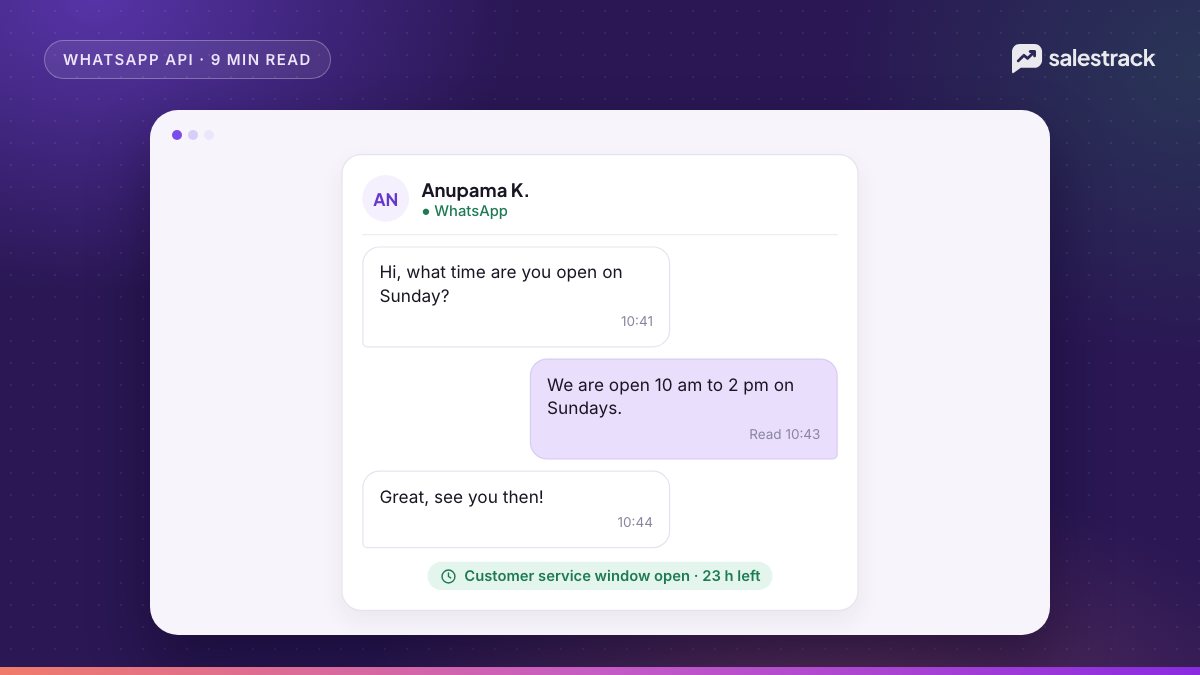
| Service | Free-form replies (text, images, documents, lists) written by your team or a third-party bot | Only inside an open 24-hour customer service window |
| Meta Business Agent | Replies written by Meta's own AI agent platform (added 1 July 2026) | Only inside an open customer service window |
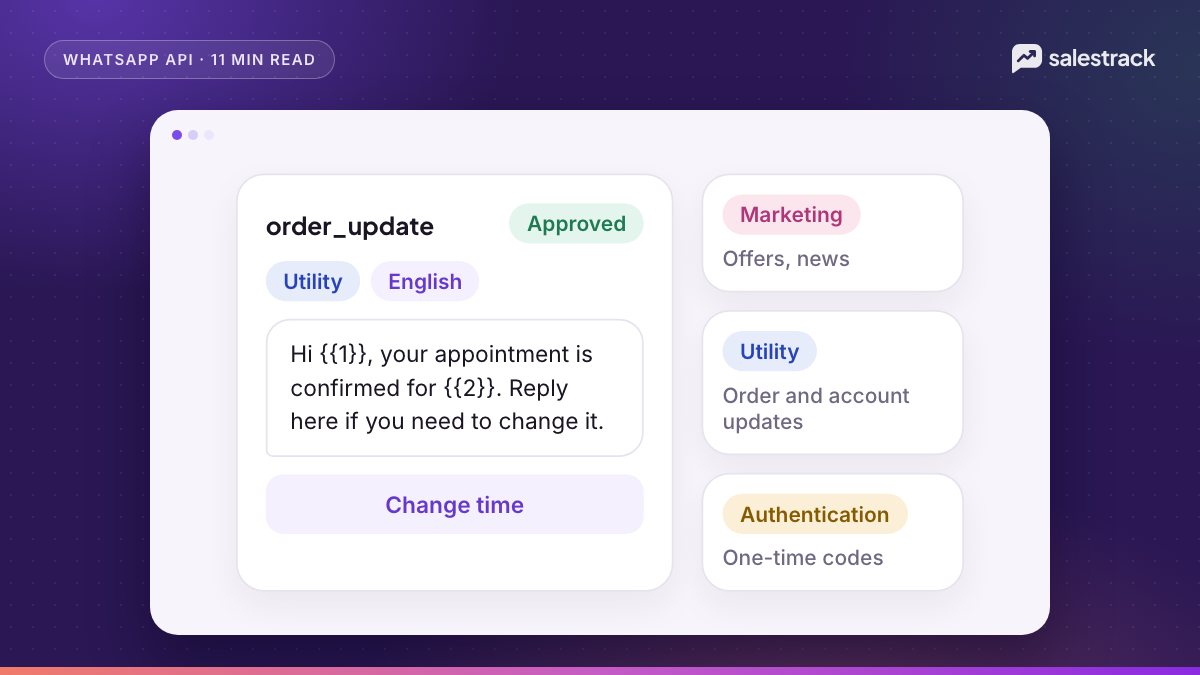
The category is decided by the template's approved category, not by what you call it. If Meta decides a "utility" template is really promotional, it is billed as marketing. Our guide to template categories and approval covers how to stay in the right category.
Authentication-international
In 18 markets, including India, UAE, Saudi Arabia, Nigeria and South Africa, Meta charges a higher authentication-international rate when a business based outside that country sends OTPs to its users. For India it is many times the domestic authentication rate. Meta sends admins a 30-day notice before these charges begin, which gives you time to set your Primary Business Location correctly.
Meta Business Agent
Messages written by Meta's AI agent are billed on the tokens they use, at one global rate published on Meta's pricing page, rather than per message. These messages are charged even inside free windows.
What is free on the WhatsApp Business API
After the October 2026 changes there are two cases where Meta does not charge for a message you send, plus inbound messages:
- Free entry point window. When someone messages you from a Click-to-WhatsApp ad on the Android or iOS app and you reply within the 24-hour window, that reply is free and opens a free entry point window that can stay open for up to 7 days. Marketing, utility, authentication and service messages in that window cost nothing.
- 1,000 free service messages per number per month. Each business phone number gets 1,000 delivered service messages free each month. They reset monthly and do not roll over. Meta charges from the 1,001st.
- Messages from customers are always free.
Eligible government departments and non-profits keep free service messages beyond the 1,000 tier until 31 December 2027. The full mechanics of the windows are in our guide to free messages and the customer service window.
How to read Meta's rate card
Meta publishes its list rates as downloadable rate cards on its pricing page, in USD, INR and other billing currencies. We link to it rather than copy the numbers, because Meta can change them every quarter.
- Rows are markets. Find the recipient's country. Smaller countries are grouped, for example "Rest of Middle East" (which includes Bahrain) or "Rest of Africa" (which includes Kenya).
- Columns are categories: marketing, utility, authentication, authentication-international and service. On the current card, service messages beyond the free tier cost the same as utility in every market.
- Use the card in your billing currency. Indian businesses billed in INR should read the INR card, not convert the USD one.
- Utility and authentication have volume tiers, in a separate sheet. Most small businesses never reach the first discount.
As a rule of thumb, marketing is the most expensive category everywhere, and Gulf and UK rates are several times India's. Your provider's wallet should show you the rate it charges for each country and category before you send.
What changed in 2026
Meta updated rates on all four calendar dates this year. The changes that matter most for India, the Gulf, Africa and the UK:
- 1 January 2026: India marketing rate went up. North America utility and authentication went down. INR billing launched for Indian businesses.
- 1 April 2026: Saudi Arabia marketing went up. India authentication-international went up. AED and SAR became billing currencies.
- 1 July 2026: UK marketing went up. Qatar moved out of "Rest of Middle East" to its own utility and authentication rates. The Meta Business Agent category was introduced.
- 1 October 2026: Service messages beyond 1,000 per number and utility templates inside the service window became charged. Marketing went up in the UAE, Saudi Arabia, Kuwait and "Rest of Middle East". Kuwait and Oman got their own rates instead of the regional rate. South Africa utility and authentication went up. Nine markets got new authentication-international rates.
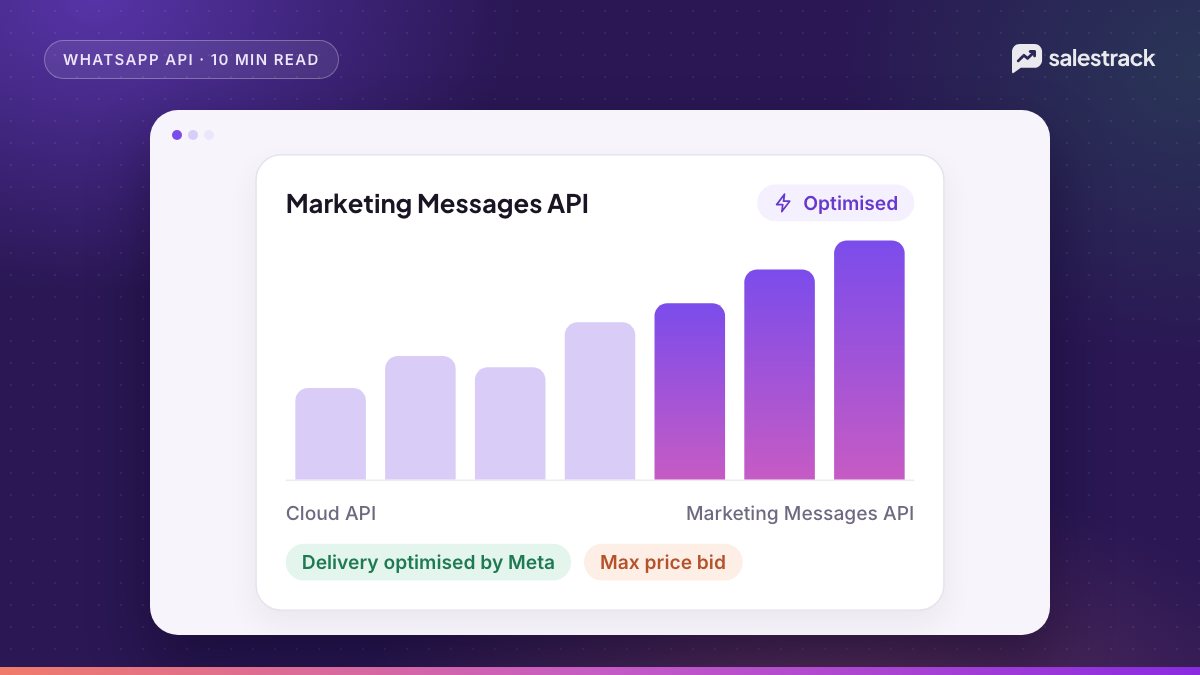
Also new in 2026: businesses on the Marketing Messages API for WhatsApp can set a max price per marketing message, which Meta describes as a bid cap. It entered open beta in October 2026. We explain it in our guide to the Marketing Messages API.
Volume tiers, currency and billing
Volume tiers
Utility and authentication messages get cheaper per message once you pass set monthly volumes in a market. Marketing and service messages have no tiers. The rules:
- Volume is counted across all Messaging accounts in your business portfolio, separately for each market and category (for example India utility).
- Only charged messages count, so free messages inside a free entry point window do not move you up a tier.
- Counts reset at midnight on the first of each month, in your Messaging account's time zone.
The thresholds are high for most small businesses. In India, the utility list rate applies up to 25 million messages a month before the first discount starts, according to the INR volume tier sheet.
Currency
Sixteen billing currencies are available as of July 2026, including USD, INR, AED, SAR, GBP and EUR. You choose the currency when the Messaging account is created and cannot change it later, although Meta now offers Currency Migration APIs to move. Indian businesses need to note one deadline: eligible accounts must be on INR by 31 December 2026, or Meta stops delivering their messages from 1 January 2027.
Who you pay
If you connect through a provider (a Solution Partner or a CRM using one), you usually prepay a wallet or receive an invoice from that provider, at the rates it shows you. If you integrate directly, Meta bills the payment method in your Billing Hub.
How to estimate a month's bill
You can estimate your WhatsApp costs before you spend anything. For each line, multiply the number of messages by the rate for that category and country from the rate card (or from your provider's wallet):
| Messages | Category | What you pay for |
|---|---|---|
| Offer or festive campaign to past customers | Marketing | Every delivered message, at the marketing rate |
| Appointment or order reminders | Utility | Every delivered message, at the utility rate (lower than marketing) |
| Team replies to customer chats | Service | Only replies above 1,000 a month per number |
| All messages to leads from Click-to-WhatsApp ads, inside free windows | Any | Nothing |
Three things usually stand out. Marketing is most of the bill even when it is a small share of the messages. Replies to ad leads cost nothing when the team answers inside the window. And the 1,000 free service messages cover much of a small team's chat volume.
How salestrack handles message costs
salestrack CRM by Dentobees connects to the official WhatsApp Business API, and message charges come from a prepaid WhatsApp wallet. The wallet shows the rate for each country and message type before you top up. Before a broadcast goes out, salestrack shows its cost against your wallet balance, and a low-balance guard stops a campaign from going out half sent. The shared inbox shows a 24-hour window timer on every chat, so your team replies while service messages are still the cheap option. If you run Click-to-WhatsApp ads, Meta ads ROI shows which ads bring paying customers. Plan details are on the pricing page and broadcast features on WhatsApp broadcasts.
FAQ
How much does the WhatsApp Business API cost per message in India?
Meta sets a rate per delivered message for each category and country, published in its rate card in USD and INR. In India, as everywhere, marketing messages cost the most and utility, authentication and charged service messages cost much less. Rates can change each quarter, so check the current rate card on Meta's pricing page.
Is the WhatsApp Business API free?
Not entirely. Messages customers send you are free, every business phone number gets 1,000 free service messages a month, and all messages inside a free entry point window from a Click-to-WhatsApp ad are free. Everything else is charged per delivered message.
Are WhatsApp service messages still free in 2026?
No longer without limit. From 1 October 2026 Meta charges for service messages after the first 1,000 per business phone number each month. Eligible government and non-profit organisations keep free service messages until 31 December 2027.
Does Meta charge for messages that are not delivered?
No. Meta charges only when a message is delivered, not when it is sent. Messages from users to your business are never charged.
Can I pay for WhatsApp API messages in rupees?
Yes. INR billing launched on 1 January 2026 for businesses whose Sold-To country is India. Eligible businesses must move all Messaging accounts to INR by 31 December 2026, or Meta stops delivering their messages from 1 January 2027.
Why is my marketing message more expensive in the UK than in India?
Meta prices each category per market, based on the recipient's country calling code. Marketing rates for the UK and the Gulf are several times the India rate on Meta's rate card, so the same campaign costs more there.
Sources
Facts in this article were checked against these sources on 1 November 2026. WhatsApp and Meta change their rules and prices often, so check the source before you rely on a number.
- Pricing on the WhatsApp Business Platform — Meta for Developers (updated 30 Sep 2026)
- USD and INR list rate cards, effective 1 October 2026 — linked from Meta's pricing page
- Authentication-international rates — Meta for Developers
- Marketing Messages API for WhatsApp: max price — Meta for Developers
- Marketing Messages API for WhatsApp: geographic availability (US marketing restriction) — Meta for Developers