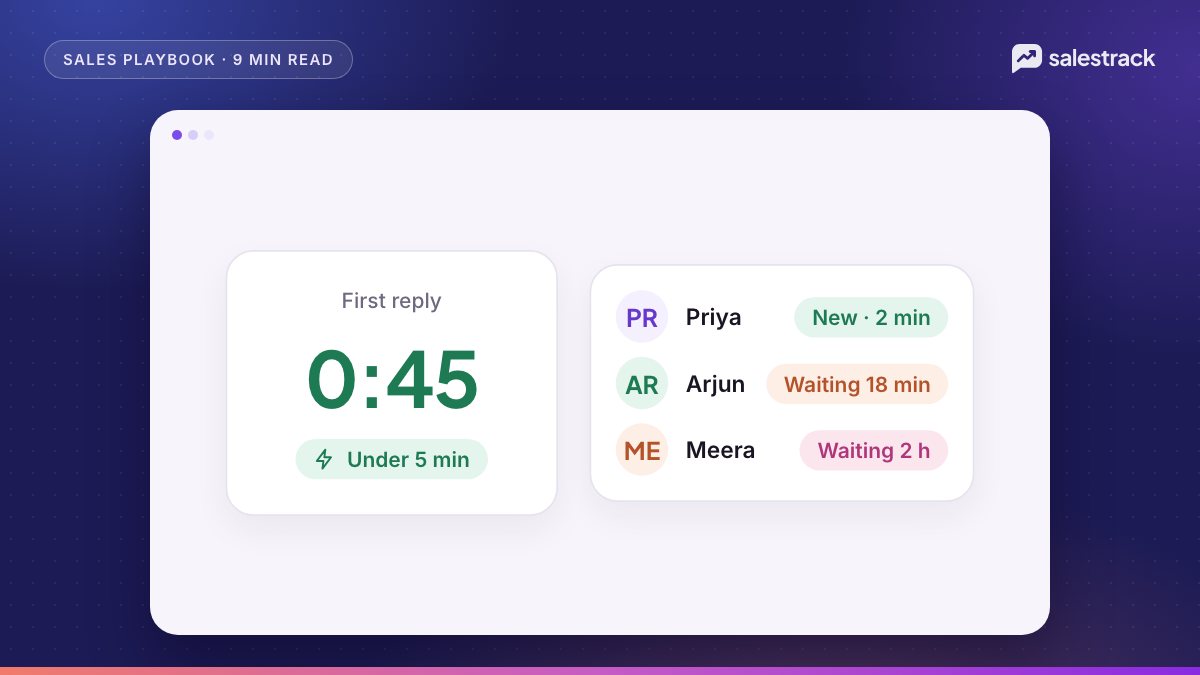
Speed to lead is the time between someone enquiring and your team making first contact. For leads from Meta ads and WhatsApp, the practical target is a first reply in under five minutes, every hour of the day, followed by a real conversation with a person as soon as possible. The longer a lead waits, the less likely you are to reach them at all.
The research behind this is older and narrower than most blog posts admit, but it points one way. A 2011 Harvard Business Review study found that firms that tried to contact a lead within an hour were nearly seven times as likely to qualify it as firms that waited an hour longer. An earlier InsideSales.com and MIT study reported that calling within 5 minutes instead of 30 made contact about 100 times more likely.
This guide covers what those studies actually measured, how to track your own first-response time without fooling yourself, and a setup that gets you under five minutes, including nights, weekends and festival rushes.
What speed to lead means for a WhatsApp sales team
A lead is never more interested than in the minute after they tap "Submit" on a Meta lead form or send "Hi, price?" from a Click-to-WhatsApp ad. They have your ad on screen. They are probably also looking at two competitors. Whoever answers first, with something useful, usually gets the conversation.
For most small and mid-size businesses in India and the Gulf, three things make speed harder than it should be:
- Leads arrive in the wrong place. Lead form entries sit in Meta's Leads Center or a downloaded CSV until someone checks. WhatsApp chats land on one phone.
- Nobody owns the lead yet. The lead is visible to everyone, so nobody replies. Or it is forwarded by hand, which adds 20 minutes on a good day.
- Ads run 24 hours, teams do not. A clinic or real estate project often gets a third of its enquiries after office hours, and those wait until morning.
Fixing speed to lead is less about telling people to "be faster" and more about removing these three delays with process and tools.
What the research actually says
Two studies are quoted everywhere. They are often mixed up, so here is what each one found.
Harvard Business Review, 2011
In "The Short Life of Online Sales Leads" (March 2011), James Oldroyd, Kristina McElheran and David Elkington did two things. First, they audited 2,241 US companies by sending a test web lead and timing the reply: 37% responded within an hour, 16% within one to 24 hours, 24% took longer than 24 hours, and 23% never responded. Among companies that replied within 30 days, the average response time was 42 hours.
Second, they analysed 1.25 million leads received by 42 US companies (29 B2C, 13 B2B). Firms that tried to contact a lead within an hour were nearly seven times as likely to qualify it as firms that tried an hour later, and more than 60 times as likely as firms that waited 24 hours or more.
Lead Response Management study, 2007
The "five-minute rule" comes from the InsideSales.com/MIT Lead Response Management study, presented in October 2007 by Dave Elkington and James Oldroyd. It looked at three years of data from six companies, more than 15,000 web leads and over 100,000 call attempts. It reported that the odds of contacting a lead were 100 times higher when called within 5 minutes versus 30 minutes, and the odds of qualifying it were 21 times higher.
| Study | What was measured | Headline finding |
|---|---|---|
| HBR audit, 2011 | Reply time to a test lead at 2,241 US firms | 23% never replied; average reply 42 hours among those that did |
| HBR lead analysis, 2011 | 1.25 million leads at 42 US firms | Within an hour: ~7x as likely to qualify vs an hour later; 60x+ vs 24 hours or more |
| LRM study, 2007 | 15,000+ web leads, 100,000+ calls at six firms | 5 minutes vs 30 minutes: 100x contact odds, 21x qualify odds |
The honest summary: every serious study points the same way, and the effect is large enough that even a fraction of it is worth chasing. You do not need the exact multiplier to know that a lead answered in three minutes beats a lead answered tomorrow.
Why speed matters even more on WhatsApp
WhatsApp adds a few reasons of its own to reply fast.
- The 24-hour customer service window. When a lead messages you, a 24-hour window opens in which you can send normal free-form replies. Once it closes, you can only send pre-approved template messages, according to Meta's WhatsApp pricing documentation. A slow team ends up paying for templates to restart conversations it could have continued for less. Our guide to the customer service window has the details.
- Free entry point for Click-to-WhatsApp ads. If someone messages you from a Click-to-WhatsApp ad on the Android or iOS app and you reply within the 24-hour window, Meta opens a free entry point window that its pricing page says can stay open for up to 7 days, during which messages are not charged. Miss that first reply and you lose the cheapest stretch of the conversation.
- Chat expectations. People reply to friends in seconds. A business that answers a WhatsApp message the next morning feels like it is not open.
Lead form leads are different: the person has given you a phone number but has not messaged you, so no window is open. Your first WhatsApp message to them must be an approved template. Plan that template in advance so it can go out automatically. Our guide to sending Facebook lead ads to WhatsApp covers the setup.
How to measure first-response time
You cannot improve what you measure badly. Most teams measure response time in a way that hides the problem. Set it up like this.
- Record the lead's created time from the source. Use the time the form was submitted or the first WhatsApp message arrived, not the time someone imported or opened it.
- Record two reply times. Time to first reply (any message, including an automatic one) and time to first human contact (a person sends a message or connects a call). The first tells you if leads are acknowledged. The second tells you if your team is actually working them.
- Use the median, not the average. One lead answered after three days drags an average up and hides the fact that most leads were answered in two minutes, or the reverse. Report the median and the share answered within 5 minutes.
- Split by hour and day. A team with a 3-minute median at 11 am and a 9-hour median at 9 pm has a staffing problem, not a training problem.
- Split by person and by source. Compare salespeople against each other and compare lead form leads against Click-to-WhatsApp chats.
- Count the never-contacted leads. Leads with no human contact after 24 hours should be a number on the manager's screen every morning.
For example, a dental clinic's weekly view might look like this (illustrative numbers):
| Time the lead arrived | Leads | Median first reply | Median first human contact | Within 5 min (human) |
|---|---|---|---|---|
| 9 am – 1 pm | 58 | 1 min | 4 min | 62% |
| 1 pm – 6 pm | 71 | 1 min | 11 min | 38% |
| 6 pm – 10 pm | 49 | 1 min | 13 hours | 4% |
| 10 pm – 9 am | 22 | 1 min | 11 hours | 0% |
The automatic reply is doing its job. The real gap is the evening, when a quarter of leads arrive and nobody calls until the next day. That is where to put a person or an AI agent first. The sales reports and KPIs guide shows how first response time fits with the other numbers a manager should track.
How to reply to every lead in under 5 minutes
Here is the setup we recommend, in the order that gives the biggest gain for the least effort.
- Get leads into one place instantly. Connect Meta lead forms, Click-to-WhatsApp chats, website forms and Google Ads leads to one list or CRM in real time. Downloading a CSV once a day guarantees a slow response.
- Send an automatic first message within seconds. For lead form leads, an approved template: "Hi Priya, thanks for your enquiry about clear aligners at Bright Smile Clinic. Divya from our team will call you in the next few minutes. Is now a good time?" For WhatsApp chats, an instant free-form reply with one useful question.
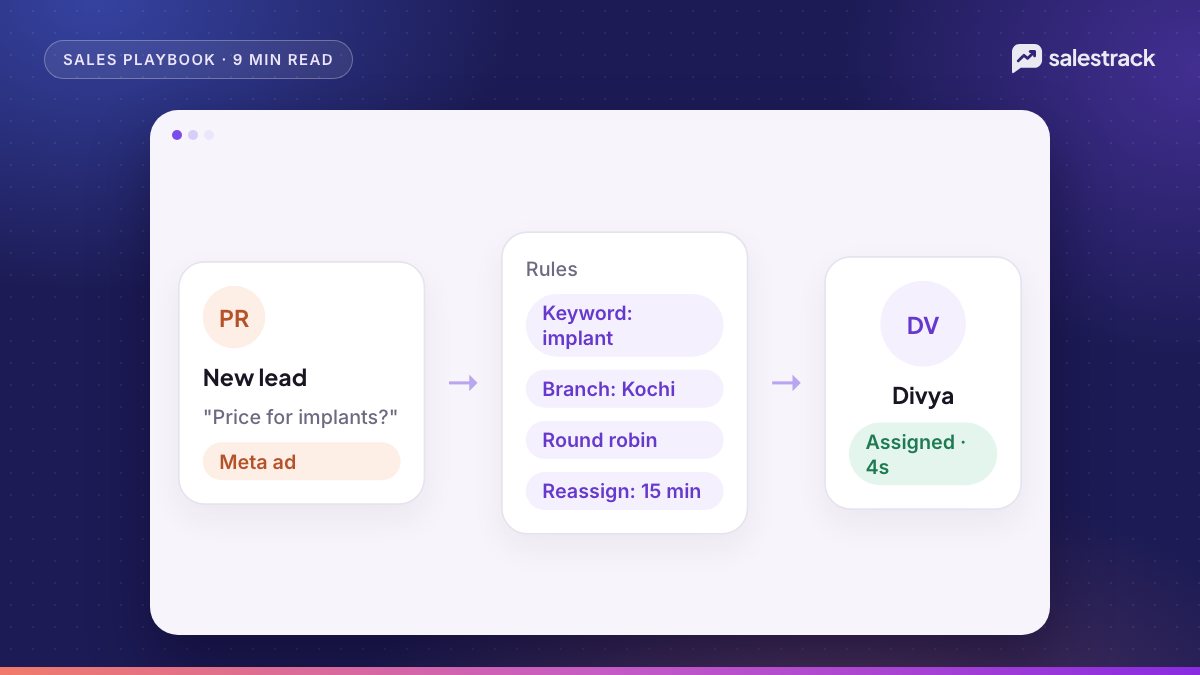
- Assign an owner the moment the lead arrives. Use assignment rules (round robin, by campaign, by branch or by language) so the lead lands with one named person, with a notification on their phone. Our guide to lead assignment rules explains the options.
- Set a reassign timer. If the owner has not contacted the lead within, say, 10 or 15 minutes, the lead moves to the next available person and the manager is told. This single rule fixes most "my best salesperson was on another call" delays.
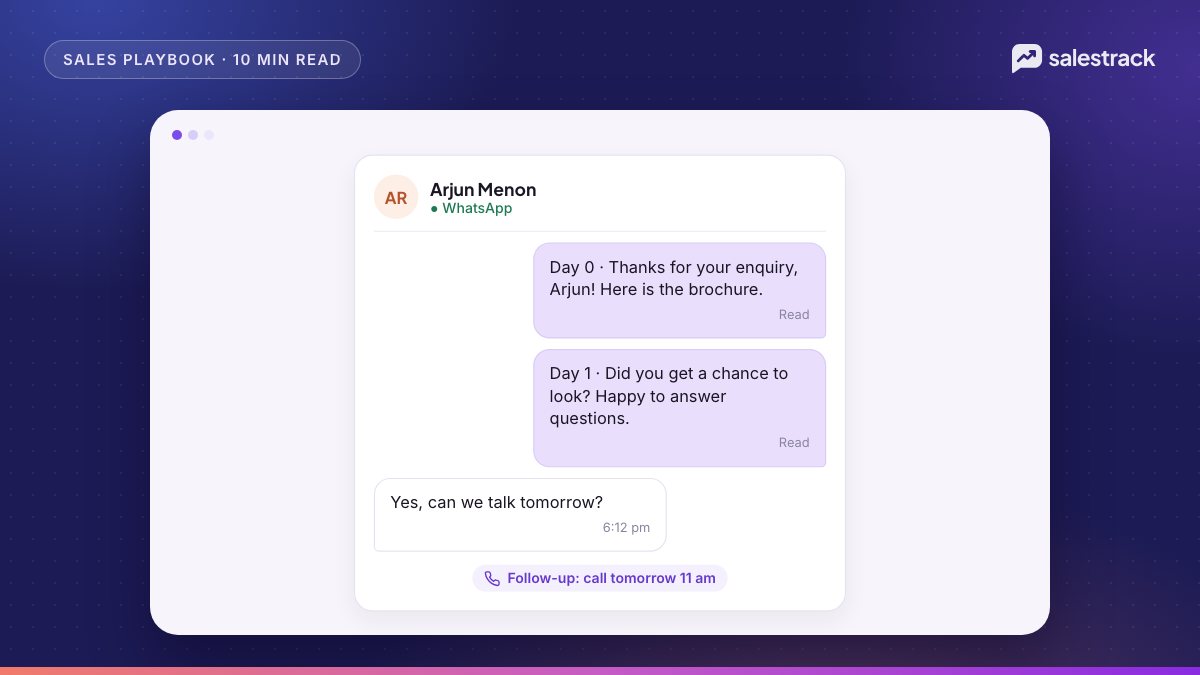
- Call and message together. In India especially, many people will not pick up an unknown number but will read a WhatsApp message. Send the WhatsApp message first, then call. If the call is missed, send a short "Tried calling you just now" message.
- Give salespeople ready answers. Saved replies for price ranges, location, timings and documents needed cut the time between the first hello and a useful answer.
- Review the numbers every week. Look at median first human contact and leads never contacted, by person and by hour. Coach the slowest two people, not the whole team.
Covering nights, weekends and holidays
Ads keep spending after your team goes home. Pausing ads at night is one answer, but it often costs you cheap leads. A better approach has three layers.
1. An after-hours reply with a real next step
"We are closed" is not a reply. Give the lead something to do: a booking link, a brochure or price list, or a promise with a time, such as "Rahul will call you at 10 am tomorrow. Reply 1 if a different time suits you." Then make sure the call happens at 10 am.
2. An AI agent or on-call person for questions
Many night leads only want a price range, a location or a timing. An AI agent working from your own information can answer these, ask your qualifying questions and hand hot leads to a person. The WhatsApp Business Messaging Policy allows automation and requires clear ways to reach a human, so always offer that path. If you do not use AI, a rota where one person checks leads every hour until 10 pm works well for real estate and travel, where a late enquiry can be a serious buyer.
3. A morning queue that is worked first
Every overnight lead should be in a single "reply now" list with an owner before the team arrives. The first hour of the day is for those leads, oldest first. Weekend days differ between India and the Gulf states, so set office hours per branch rather than one company-wide schedule.
How salestrack helps with speed to lead
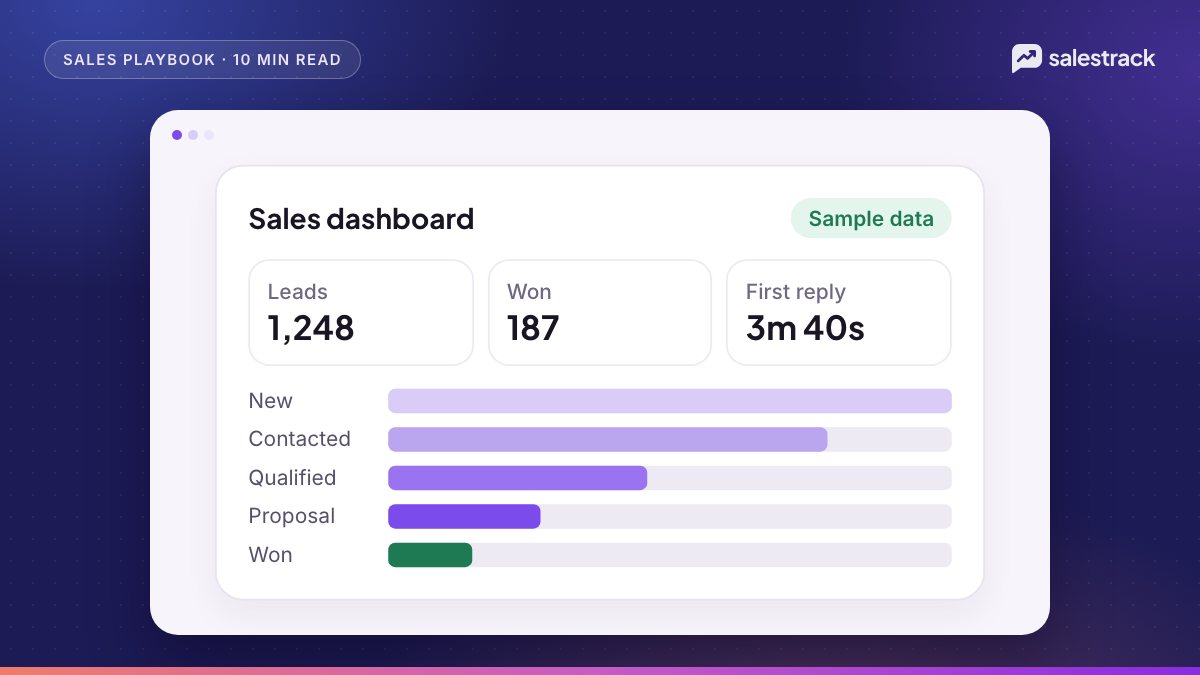
salestrack CRM by Dentobees was built around this problem. Meta lead ads, Click-to-WhatsApp chats, Google Ads and website leads arrive in one list with a first-reply timer on each. Lead assignment rules give every lead an owner in seconds and reassign leads nobody contacts within the time you set. On the Growth plan, the AI sales agent replies to new leads on WhatsApp day and night, asks your qualifying questions and hands hot leads over with a summary. Response-time reports show median first reply by person, team and hour of day. You can start on the free plan and see pricing when you add WhatsApp.
FAQ
What is speed to lead?
Speed to lead is the time between a lead enquiring (submitting a form or sending a WhatsApp message) and your business making its first real contact. Shorter is better, and most sales teams aim for under five minutes.
What is a good lead response time?
Under five minutes for the first reply is a strong target for leads from ads. The 2011 Harvard Business Review research found firms that responded within an hour were nearly seven times as likely to qualify a lead as firms that waited an hour longer.
Where does the 5-minute rule come from?
It comes from the 2007 InsideSales.com and MIT Lead Response Management study, which reported that the odds of contacting a web lead were 100 times higher when called within 5 minutes versus 30 minutes. It studied phone calls to US web leads, so treat it as a direction, not a law.
Does an automated reply count as responding?
It counts as your first reply, and it stops the lead going cold, but it is not a conversation. Track both: time to first reply (automated or human) and time to first human contact.
How do I handle leads that come in at night?
Send an instant reply that gives a clear next step, such as a booking link or a call time, let an AI agent answer common questions if you use one, and put the lead at the top of the morning queue with a named owner.
Sources
Facts in this article were checked against these sources on 1 November 2026. WhatsApp and Meta change their rules and prices often, so check the source before you rely on a number.
- The Short Life of Online Sales Leads — Harvard Business Review, March 2011 (Oldroyd, McElheran, Elkington)
- Are you letting online leads go cold? — SmartCompany summary of the HBR study figures (2011)
- The InsideSales.com/MIT Lead Response Management Study (2007), archived PDF copy
- Pricing on the WhatsApp Business Platform — Meta for Developers
- WhatsApp Business Messaging Policy