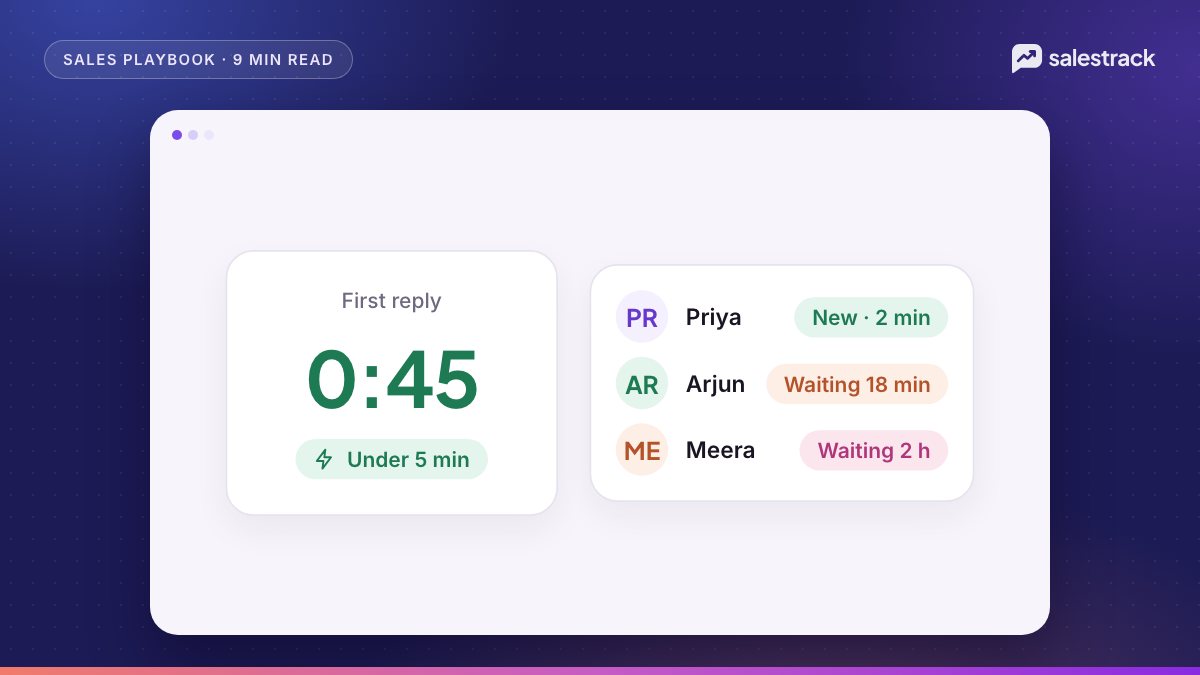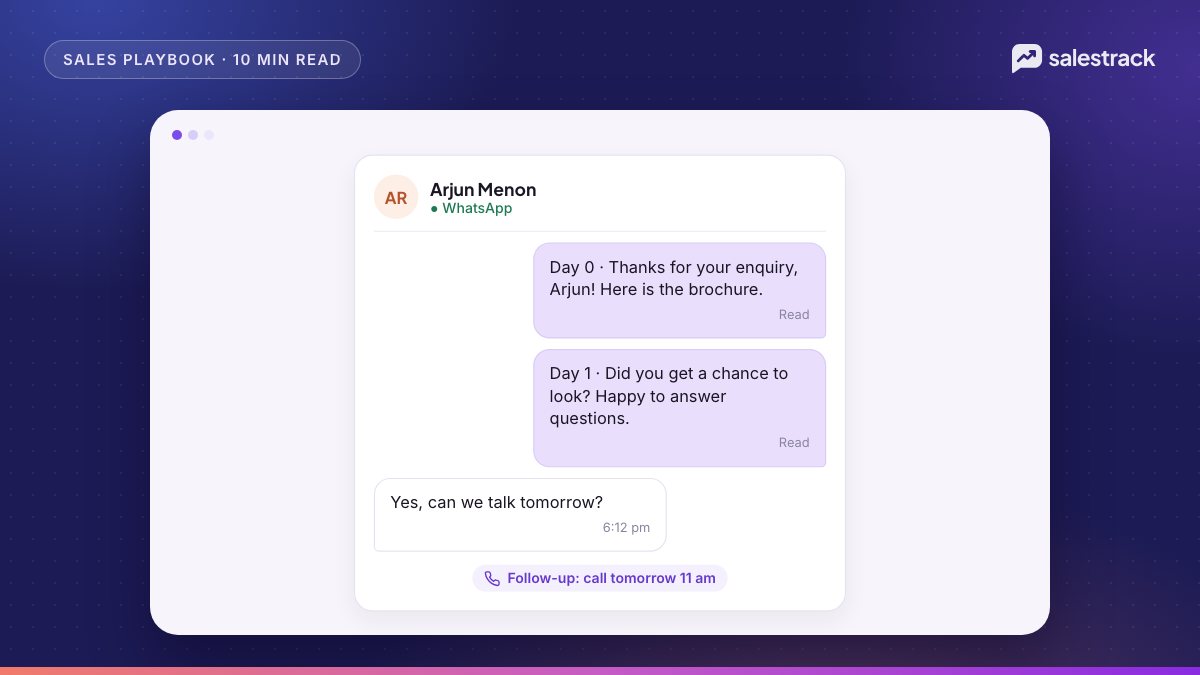
A good WhatsApp follow-up message sequence for new leads is short and useful: a reply within minutes on day 0, a nudge on day 1, a useful reason to talk on day 3, a last offer or slot on day 7, and a polite close-out around day 14. Every message stops the moment the lead replies, books or asks you to stop.
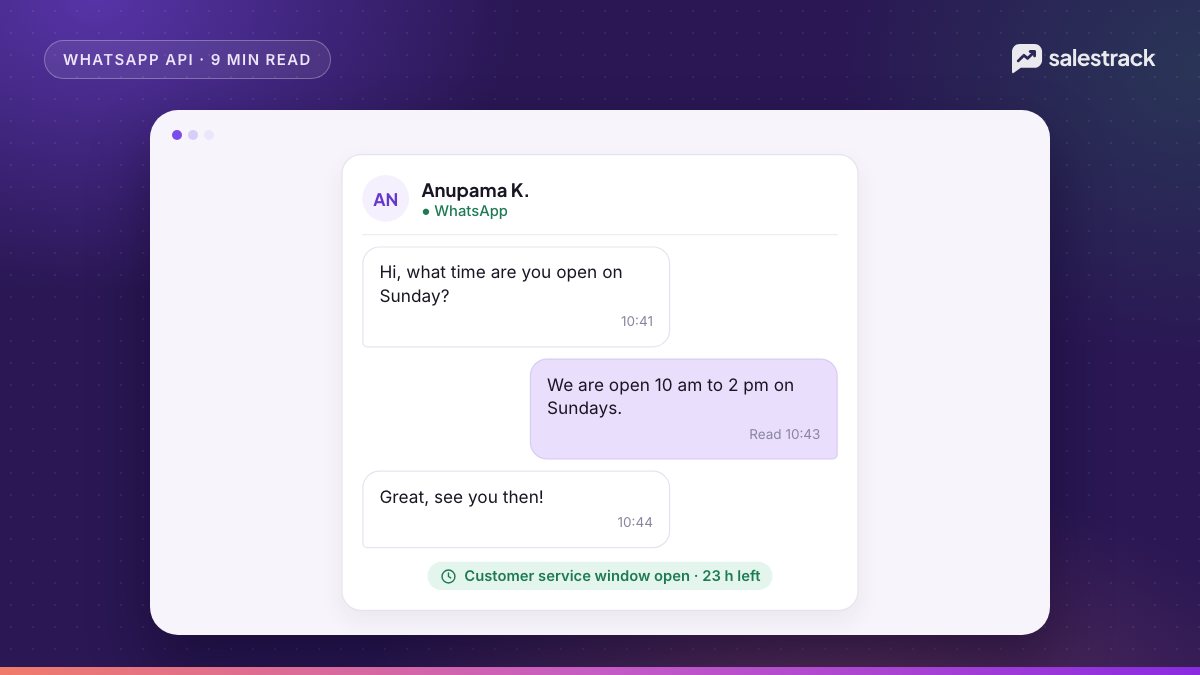
What you can send depends on WhatsApp's 24-hour customer service window. If the lead messaged you in the last 24 hours, you can reply with normal free-form text. If not, the follow-up must be a pre-approved template, and most sales follow-ups count as marketing templates.
Below is a lead follow-up sequence you can copy, with example messages for clinics, real estate, education and travel, the template rules, and the stop rules that keep your number healthy.
Why you need a lead follow-up sequence, not reminders
Most leads are lost to silence, not to a competitor's better offer. A salesperson calls once, gets no answer, writes "call back" in a notebook and moves on to the next fresh lead. Fresh leads always feel more urgent than old ones, so the second and third attempts never happen.
A written sequence fixes this. Everyone knows how many touches a lead gets, on which days and with what message. A manager can check whether it happened. And when part of it is automated, it happens even on a busy Saturday.
Persistence matters on the phone too. The 2007 InsideSales.com/MIT Lead Response Management study found that the odds of reaching and qualifying web leads dropped sharply over time and that, after about 20 hours, extra dials actually hurt the chance of contact and qualification. The lesson for WhatsApp is the same: front-load your effort in the first day, then space messages out.
The lead follow-up sequence: day 0 to day 14
This cadence works for most high-intent leads from Meta lead forms and Click-to-WhatsApp ads. Adjust the gaps for your sales cycle: shorter for a travel package, longer for a property purchase.
| When | Channel | Goal | Usually needs a template? |
|---|---|---|---|
| Day 0, within 5 minutes | WhatsApp message, then call | Acknowledge, ask one question, connect | Yes for lead forms; no for WhatsApp chats |
| Day 0, 3–4 hours later | Second call attempt | Reach them at a different time of day | No (phone) |
| Day 1 | Gentle nudge plus one useful detail | Yes, unless they replied in the last 24 hours | |
| Day 3 | WhatsApp, then call | Give a reason to talk: offer, slot, case example | Usually yes |
| Day 7 | A specific slot or time-bound offer | Usually yes | |
| Day 14 | Polite close-out, leave the door open | Usually yes | |
| After day 14 | Occasional broadcast | Nurture, only if they opted in to updates | Yes |
That is four to five WhatsApp messages and two to four calls over two weeks. More than that rarely helps and starts to look like spam.
WhatsApp follow-up message examples
Keep each message under about 300 characters, use the person's name, mention what they asked about, add one useful thing and end with one easy question. Here are examples by step and industry. Placeholders such as [Name] are filled from the lead (in an approved template they become variables).
Day 0: first reply
Hi [Name], thanks for your enquiry about clear aligners at Bright Smile Clinic. I'm Divya from the clinic. Is this for you or for someone in your family?
Hi [Name], thanks for your interest in Palm Grove 2BHK apartments. Would you like the floor plan and price sheet here on WhatsApp?
Day 1: gentle nudge
Hi [Name], Rahul here from Skyline Academy. You asked about the NEET 2027 batch. The weekend batch starts on 15 November and has 12 seats left. Shall I share the fee details?
Day 3: a reason to talk
Hi [Name], many people ask us how long aligner treatment takes. For most adults it is 6 to 12 months, and the first scan is free this month. Would Saturday morning work for a 20-minute visit?
Hi [Name], the Kerala 5-day family package you asked about has December dates filling up. I can hold 2 rooms for 24 hours while you decide. Shall I?
Day 7: a specific slot
Hi [Name], we have site-visit slots this Friday at 11 am and Saturday at 4 pm, with pick-up from Kakkanad. Reply 1 or 2 and I'll confirm.
Day 14: close-out
Hi [Name], I haven't heard back, so I won't keep messaging. If you'd still like help with your [interest] plans, just reply here any time and I'll pick it up.
When you need templates and when free-form is fine
WhatsApp has one rule that shapes every follow-up. According to Meta's WhatsApp pricing documentation, when a person messages or calls your business, a 24-hour customer service window opens, and every new message from them resets it. Inside the window you can send free-form messages. Outside it you can only send approved template messages. Our guide to the customer service window explains the details.
| Situation | What you can send |
|---|---|
| Lead filled a Meta lead form, never messaged you | Template only |
| Lead messaged from a Click-to-WhatsApp ad in the last 24 hours | Free-form replies |
| Lead replied to your template 3 hours ago | Free-form replies until 24 hours after their last message |
| Lead's last message was 2 days ago | Template only |
Which template category?
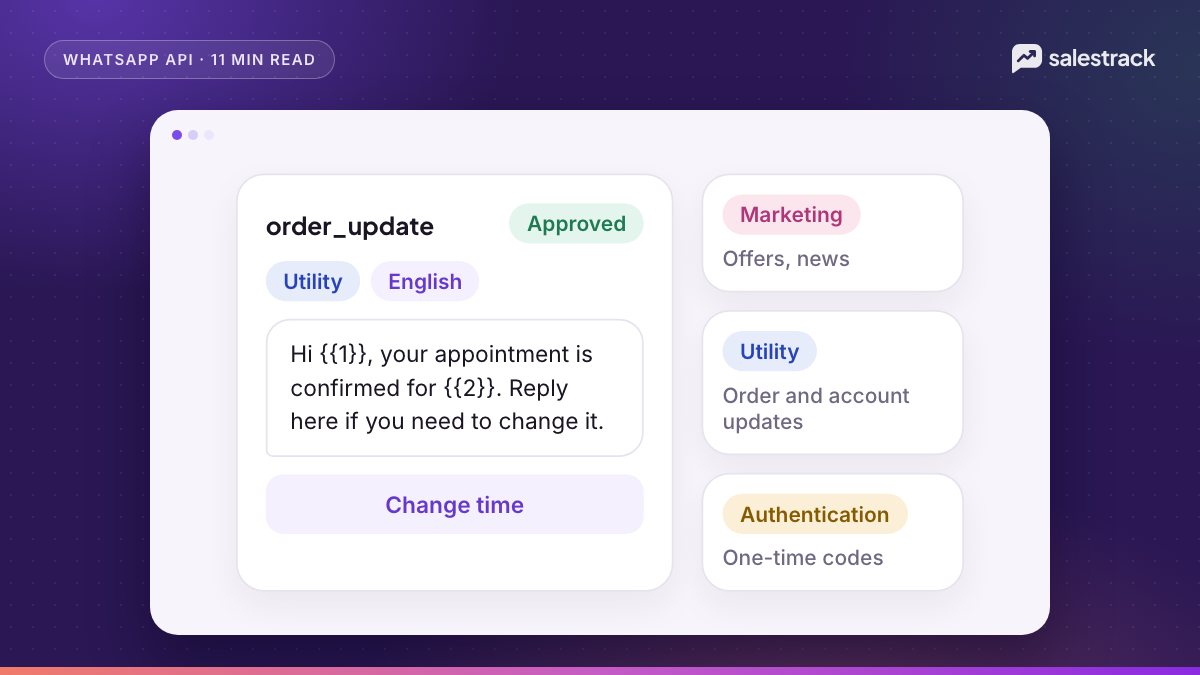
Meta's template category guidelines say utility templates are typically triggered by a user action or request and must be non-promotional. Templates with persuasive intent, re-engagement or mixed content are marketing. In practice, almost every sales follow-up ("still interested?", "offer ends Friday", "shall I book you?") is a marketing template. An appointment confirmation or a document the lead requested can be utility. Do not try to slip sales nudges into utility templates; Meta reviews and can re-categorise them. Our guide to template categories and approval goes deeper.
Cost
Meta charges per delivered template message, by category and country. Its pricing page also says that from 1 October 2026 service messages are charged beyond a free tier of 1,000 per phone number per month, and utility messages sent inside an open window are charged again. Click-to-WhatsApp leads get a free entry point window when you reply within 24 hours, which Meta says can stay open for up to 7 days. Check current rates on the official rate card, and see our WhatsApp Business API pricing guide for the details.
When to stop following up
A sequence needs stop rules as much as it needs messages. Stop, or switch to a different path, when any of these happens:
- The lead replies. A person takes over. Nothing is more awkward than an automatic "Just checking in!" arriving after the lead has said "I'll come Saturday".
- The lead books, buys or visits. Move them to a different sequence: confirmations, reminders and after-visit follow-up.
- The lead says no or asks you to stop. Close the lead with a reason and stop all marketing messages.
- The sequence ends with no reply. Close the lead as "no response" so reports stay honest. Keep them for occasional broadcasts only if they opted in to updates.
- A salesperson changes the stage manually. Stage changes should end the old sequence and start the right new one.
Respecting opt-outs and staying within policy
The WhatsApp Business Messaging Policy says you may only message people who have given you their number and opted in, and that you must respect all requests to block, stop or opt out of messages. It also notes that users can block or report businesses, and that this feedback can limit your messaging.
In practice:
- Make the opt-in clear on your lead form or ad ("We'll contact you on WhatsApp about your enquiry").
- Add a simple opt-out line to marketing templates, such as "Reply STOP to stop these messages", or use a quick-reply button.
- Treat "stop", "not interested", "don't message" and similar replies as opt-outs, in every language your team uses.
- Record the opt-out on the contact so broadcasts and sequences skip them automatically.
- Watch block and report signals. If many people block you after a template, rewrite it.
Running follow-up sequences in salestrack
In salestrack, automated follow-ups run sequences of approved templates by stage and source, with delays in hours or days, and stop on a reply, a stage change or an opt-out. After-hours automation sends night leads a next step, and the My day screen shows each salesperson the chats waiting, overdue follow-ups and today's calls. Templates are built and checked before submission in broadcasts and templates, and opted-out contacts are excluded automatically. Sequences are included on Growth, or added per workflow on Starter; see pricing.
FAQ
How many times should I follow up a lead on WhatsApp?
For most new leads, four to five messages over about two weeks is enough: day 0, day 1, day 3, day 7 and a final message around day 14. Stop as soon as they reply, book or ask you to stop.
Do I need a template for a WhatsApp follow-up message?
Only if the 24-hour customer service window is closed. If the lead messaged you in the last 24 hours you can send a normal free-form reply. Otherwise the follow-up must be an approved template.
Is a follow-up message marketing or utility?
Most sales follow-ups are marketing templates under Meta's guidelines, because they aim to persuade or re-engage. Utility is for non-promotional messages tied to something the person did or requested, such as an appointment confirmation.
What should I write in a WhatsApp follow-up message?
One short message with the person's name, a reminder of what they asked about, one useful piece of information and one easy question. Avoid long paragraphs, repeated "just checking in" messages and pressure.
What if a lead says stop?
Stop all marketing follow-ups to that number immediately and record the opt-out in your CRM. WhatsApp's Business Messaging Policy requires businesses to respect all requests to opt out.
Why did my follow-up template fail with error 131049?
WhatsApp limits how many marketing templates a person receives from businesses, based on their engagement. Meta's guidance is to wait at least 24 hours before trying again rather than retrying immediately.
Sources
Facts in this article were checked against these sources on 1 November 2026. WhatsApp and Meta change their rules and prices often, so check the source before you rely on a number.